
Fishing Float Tubes — How to Choose a Float Tube or Belly Boat
( number of products: 7 )A fishing float tube, also known as a belly boat, lets an angler fish from a seated position and manoeuvre with fins on sheltered stillwater. It provides access to shelves, bays and weed margins that cannot be reached from the bank, while packing into far less space than a boat once deflated.
This category contains open-front Outcast float tubes: the compact Fish Cat, roomier Fat Cat and largest Prowler, together with fins and a pump. Compare total load capacity for the angler and all equipment, seat type, weight, inflated dimensions and packed bulk. Always confirm the exact specifications on the individual product page.


What is a fishing float tube?
A modern fishing float tube is a compact inflatable in which the angler sits between two side tubes with the legs extending through an open front. Fins provide propulsion and small corrections of position. The hands remain available for the rod, although line, obstructions and drift still require attention whenever the craft is moving.
The terms float tube and belly boat are now often used interchangeably. The actual construction matters more than the label: hull shape, seat height, air-cell arrangement and material, load capacity, storage and the angler's position above the water. Every float tube shown in this category has an open front and is intended primarily for stillwater fishing.
How should you choose a float tube?
Begin with the water and the duration of a typical session. A compact craft that is easy to carry from the vehicle can be sufficient for a small, sheltered lake. On larger stillwaters, storage space, seat height, back support and reserve load capacity become more noticeable. A larger float tube is not automatically better: it provides room but is wider, heavier and bulkier in transit.
Do not compare load capacity with body weight alone. Waders, boots, buoyancy aid, clothing, rods, reels, fly boxes, drinks and all other baggage add to the load. The stated figure is a limit for the entire load, not a recommended target. A sensible margin supports the intended riding position but cannot compensate for unsuitable weather or water.
| Model | Inflated dimensions | Weight | Load capacity | Seat and backrest |
|---|---|---|---|---|
| Fish Cat 4-LCS | 44 × 54 in approx. 112 × 137 cm | 14 lb approx. 6.4 kg | 250 lb approx. 113 kg | Foam |
| Fish Cat 4 Deluxe-LCS | 44 × 54 in approx. 112 × 137 cm | 14 lb approx. 6.4 kg | 250 lb approx. 113 kg | Inflatable |
| Fat Cat-LCS | 45 × 64 in approx. 114 × 163 cm | 12 lb approx. 5.4 kg | 300 lb approx. 136 kg | Foam |
| Super Fat Cat-LCS | 45 × 64 in approx. 114 × 163 cm | 12 lb approx. 5.4 kg | 300 lb approx. 136 kg | Inflatable |
| Prowler | 50 × 64 in approx. 127 × 163 cm | 16 lb approx. 7.3 kg | 325 lb approx. 147 kg | Inflatable |
The table describes the exact catalogue versions offered by Taimen; later editions with similar names may differ in construction, colour or weight. Metric values are rounded conversions of the manufacturer's figures. Check the instructions and markings supplied with the individual craft before use.
Fish Cat, Fat Cat or Prowler?
- Fish Cat 4-LCS is the shortest craft in this comparison. Its foam seat and backrest require no inflation but occupy more luggage space.
- Fish Cat 4 Deluxe-LCS retains the basic dimensions and capacity of the Fish Cat 4 but uses an inflatable seat and backrest, reducing packed bulk after deflation.
- Fat Cat-LCS adds length and a 300 lb load capacity. Foam support simplifies preparation of the seating area at the cost of greater transport volume.
- Super Fat Cat-LCS combines the Fat Cat dimensions and capacity with an inflatable seat and backrest, making it more compact once packed.
- Prowler is the largest craft and has the highest load capacity in this group. It provides more room for angler and equipment but is also the heaviest. Its anchor system is optional equipment, not a standard inclusion.
Foam or inflatable seating?
A foam seat is ready without separate pressure adjustment and retains a consistent shape. It cannot be reduced in size for transport in the way an inflatable component can. It suits anglers who value quick preparation and have sufficient luggage space.
An inflatable seat reduces packed bulk and allows support to be adjusted within the manufacturer's intended range. It requires correct inflation, valve checks and attention to the additional air cells during preparation. Do not add excess pressure merely to create an unusually hard seat.
Air cells, outer shell and valves
The listed craft use vinyl or urethane inner cells protected by an outer shell intended for normal contact with equipment and the bank. This does not make them proof against sharp stone, hooks, wire, glass or dragging over the ground. Cell material and valve arrangement vary between models, so a repair kit or pump adaptor should not be chosen from the category name alone.
Close each valve in accordance with the instructions and inspect it before entering the water. Air expands as temperature rises: do not leave a firmly inflated craft in a hot vehicle or full sun without monitoring it. Pressure can fall when a tube enters cold water, which does not necessarily indicate a puncture.
Fins, boots and pump
Fins propel the float tube, so they must remain secure on the footwear and permit controlled movement without excessive strain. The Outcast Fins in this category are step-in fins for use over wading boots, with an adjustable strap and Kicker Keepers retention lanyards. Fasten the lanyards before entering the water. Do not walk in fins farther than is necessary for a safe launch.
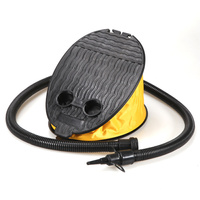
Use a pump and adaptor compatible with the model's valve and pressure range. The compact Taimen Pump Eco is a bellows-style foot pump for compatible low-pressure inflatables and can also remove air when the hose is moved to the other socket. Compatibility with every valve has not been established, so check the connection before travelling.
Fly line and equipment aboard a float tube
The adjustable stripping apron on the Outcast models helps keep part of the fly line above the water and away from the legs. It is not a workbench for open fly boxes or a place to embed hooks. Lay line in open coils, watch buckles and protrusions, and secure tackle that is not being used.
Distribute heavier items as evenly as possible between the sides. Keep the telephone, keys and documents inside a closed waterproof container, and tether tools with short retainers. Never attach an anchor to an arbitrary handle. Where a model accepts an anchor system, use only the intended points and account for snagging risk and changing conditions.
Safety on the water
- Wear a correctly fitted buoyancy aid or lifejacket appropriate to the conditions and local rules. Waders and the float tube itself do not replace one.
- Choose sheltered still water. Avoid strong current, vessel traffic, surf, thunderstorms, fog and wind that could carry you away from a safe shore.
- Inspect the equipment before launching. Check the shell, cells, valves, seams, seat, fins and retainers. Make the first trial close to a gently shelving exit.
- Dress for water temperature. Choose clothing for immersion and cooling, not merely the air temperature, and carry dry clothing.
- Leave details of the location and return time. Keep communication and a whistle on your person rather than inside luggage that could drift away.
- Stay below the load limit. Retain a margin and do not add tackle simply because another pocket is available.
A float tube is not suitable for every water. Local rules may specify safety equipment, excluded areas or how such a craft is classified. Check fishery rules, forecast, wind direction and the practical return route before fishing.
Preparing for first use
- Lay out the craft on clean ground and identify every valve and seat component.
- Inflate the cells in the order and to the pressure specified in the instructions. Do not use a high-pressure compressor without suitable control.
- Check valve closures, symmetry and correct seat installation.
- Put on the complete clothing system, buoyancy aid and fins, then practise entry and exit in shallow, calm water.
- Arrange luggage so that it cannot restrict movement, obstruct valves or fall out easily.
Cleaning, drying and storage
After fishing, remove sand, silt, plant matter and discarded line. Rinse with fresh water after saltwater exposure. Dry the shell, pockets, apron and fins thoroughly before packing; prolonged damp storage encourages odour, deposits and material damage.
Deflate without pulling on valves. Fold the craft loosely rather than repeatedly forming sharp creases at the same points. Store it away from heat, direct sunlight, fuels, solvents and rodents. Carry out a trial inflation in good time before the next season.
Frequently asked questions
Are float tube and belly boat different things?
In current tackle retail, the names often describe the same broad group of compact fishing inflatables. Suitability depends on the exact craft rather than the English term used for it.
Can a float tube be used on a river?
The models in this category are intended primarily for still water. Current, obstructions and a restricted return route greatly increase risk, so the generic term “float tube” must not be treated as confirmation of suitability for a river.
Are waders required?
The angler's legs remain in the water, so waders and boots compatible with the fins are normally used. Clothing depends on water temperature and session length, but waders do not provide the function of a buoyancy aid.
Which model is best for a first float tube?
There is no single answer. Compare the angler and equipment weight, transport method and room required. Fish Cat is compact, Fat Cat adds space and load capacity, while Prowler is the largest craft in this group.