
Bird Skins and Feather Patches for Fly Tying
( number of products: 3 )A complete bird skin or patch preserves feathers in their natural arrangement and provides multiple sizes, shapes and textures from one body area. It lets the tier select the exact feather for a hook instead of buying a separate loose pack for every size.
This section includes materials such as Hungarian partridge skins, guinea-fowl skins and soft-hackle marabou patches. They suit tiers who regularly make soft hackles, nymphs, wet flies and streamers.








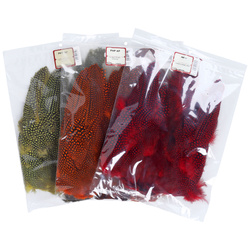


Why choose a skin?
A loose pack normally contains a selected feather type. A skin shows how plumage changes across the neck, shoulders, back, flanks and breast. Small fine feathers, broader webby hackles and patterned wing material can all be chosen from one piece, increasing flexibility and usable yield.
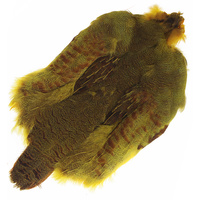
Hungarian partridge
Hungarian partridge provides naturally mottled soft hackle in a wide range of sizes. Fine neck and shoulder feathers suit smaller wet flies and nymphs; larger body feathers form collars, legs and mobile throats. Select by barb length and web rather than taking the nearest feather.
Guinea fowl
Guinea-fowl plumage carries distinctive pale spots on a dark ground. Feathers form collars, cheeks, throats and accents in wet flies, salmon flies and streamers. Natural curvature and spot scale should match the pattern.
Soft-hackle marabou patches
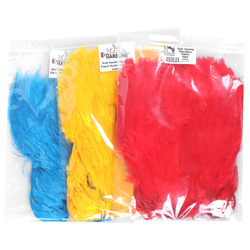
A combined patch provides soft hackle and marabou-like fibres across several lengths. It is useful for streamers, leeches, collars and larger nymphs where mobile fibres are required. Not every feather on the patch is intended to be wound; some are better used as loose barbs.
Selecting from the skin
- Measure barb length against the hook.
- Check stem flexibility at the point to be wound.
- Choose the required amount of web and mottling.
- Use corresponding left and right feathers where symmetry matters.
- Return unused feathers to the labelled skin.
Soft-hackle proportions
Traditional soft hackle often reaches approximately to the hook point or beyond, but pattern and fishing style determine the final length. Strip one side where a sparse collar is needed and wind as few turns as will create the intended movement.
Natural variation and dyeing
Marking, colour and feather density vary naturally between skins. Dyed versions add palette options but may differ in feel. This variation is useful material information, not automatically a defect.
Storage and pest control
Inspect and quarantine new natural materials, keep them completely dry and store them in sealed labelled packaging. Watch for loose dust, damaged bases or insects. Do not apply an unverified chemical that could affect feathers or later contact at the tying bench.
Frequently asked questions
Are complete skins only for advanced tiers?
No. They require some selection but teach feather structure and can be economical for anyone tying several sizes.
Can every feather on a skin be wound?
No. Some have stems too thick or shapes better suited to wings, tails, cheeks or loose fibres.
Does partridge replace a hen cape?
No. Both provide soft hackle, but their marking, stem, web and size distribution differ.