
Tail Feathers for Fly Tying
( number of products: 18 )Tail feathers supply long fibres, quills, stable vane sections and natural markings for tails, bodies, wing cases, wings and classical salmon flies. Pheasant and turkey tail, peacock eye and sword, and golden-pheasant or Lady Amherst tail materials are not one generic group: each has different barb width, stiffness and preparation.
Choose a whole feather or clump when several lengths and shades are useful. For one defined operation, a selected pair or prepared section may be more efficient.






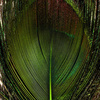

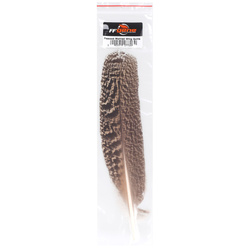
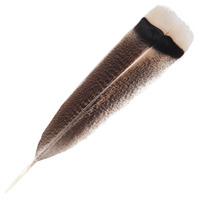
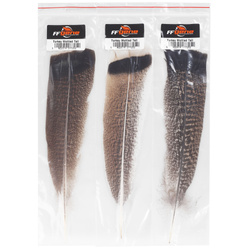


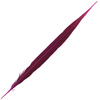

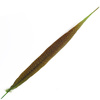


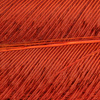

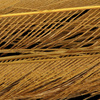

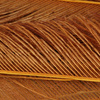



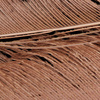
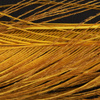


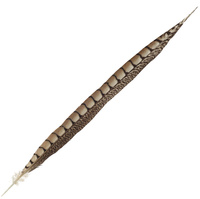
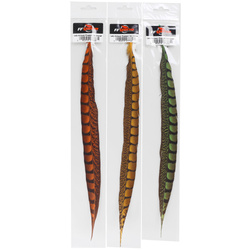


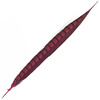

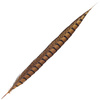


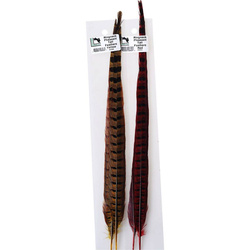



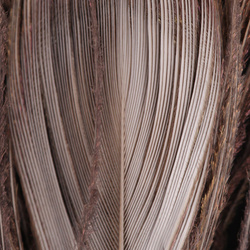
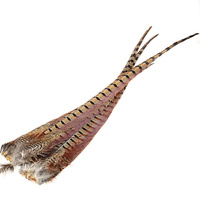


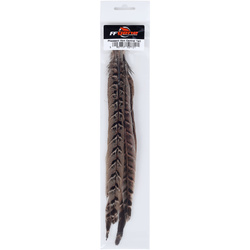







Pheasant tail
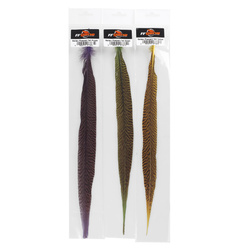
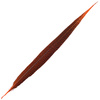
Ring-neck pheasant tail fibres form bodies, tails, wing cases and legs, most famously in Pheasant Tail nymph styles. Their natural segmentation and fine tips are useful, but repeated winding can weaken individual fibres; reinforce where the pattern requires durability.
Golden pheasant, Lady Amherst and silver pheasant provide different crests, tippets and barred or patterned components for salmon flies, streamers and classical wet flies. Use the established species and feather-part terminology.
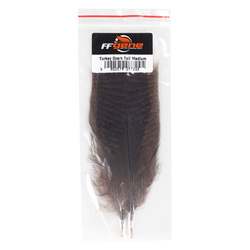
Turkey tail
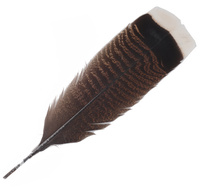
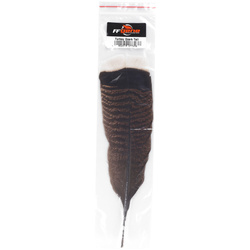
A turkey tail feather has a broad cohesive vane from which stable slips can be cut for wings, wing cases, shellbacks and bodies. Corresponding slips from left and right feathers form balanced paired wings. Reinforcement with a suitable flexible coating can improve durability where it does not impair folding.
Peacock eye and peacock sword
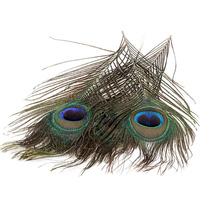
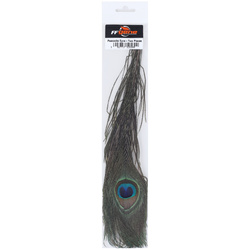
Peacock eye provides iridescent herl and a broad eye area. Stripped eye quills create naturally segmented bodies. Peacock sword has longer, firmer green-blue barbs with a different profile and is commonly used for tails, wings and lateral accents. They are not interchangeable names.
Natural and dyed tails
Natural feathers show tonal and barred variation; dyed material expands the palette while retaining underlying structure. Strong processing can affect vane cohesion or make stems brittle, so examine the working section before cutting slips.
Preparing fibres
- Identify the direction and natural curve.
- Separate the required number of fibres at right angles to the stem.
- Align tips before removing them where equal length matters.
- Cut or pull according to the pattern and feather structure.
- Keep paired slips labelled left and right.
Tail, wing or body?
The category describes where the feather grew, not the only place it can be used in a fly. Tail fibres may become a body, wing case or wing; a vane slip can form a shellback; herl can be twisted into a rope. Let structure determine the operation.
Storage
Support large feathers so that stems do not bend sharply and vanes are not crushed. Keep pairs together and protect natural material from insects. A divided vane can often be stroked back together because microscopic hooks reconnect neighbouring barbs; a broken stem cannot be restored.
Frequently asked questions
Are tail feathers only for fly tails?
No. They supply bodies, wings, wing cases, quills and many decorative or structural parts.
How do peacock eye and sword differ?
Eye feathers supply herl and stripping quills; sword feathers have longer, firmer green-blue barbs used as tails and accents.
Can a whole turkey tail feather be wound?
Usually it is used as fibres or vane slips. Its main stem is too large for conventional winding around a hook.