
Cone Heads for Streamers and Tube Flies
( number of products: 9 )A cone head does more than replace a round bead: its tapered form closes the front of a fly, controls surrounding materials and can add useful mass. It is commonly used on Woolly Buggers, leeches, streamers, tube flies and shaped baitfish or crustacean patterns.
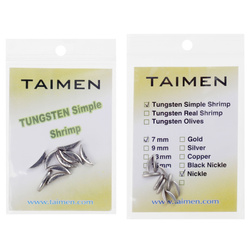
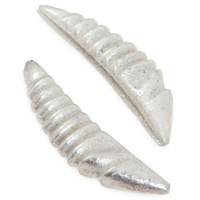
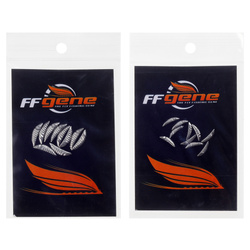
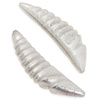
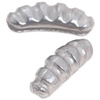
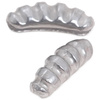
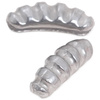
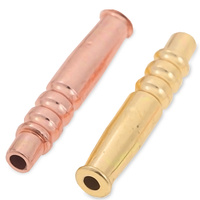
Alongside conventional tungsten and brass cones, this category can include weighted tubes, formed shrimp bodies, propellers and construction parts for tube flies. Select by the product's stated function rather than by the shape seen in a thumbnail.
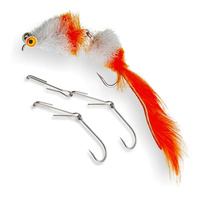










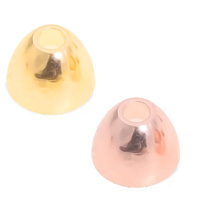

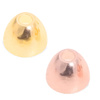
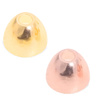
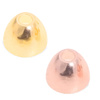
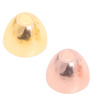




What does a cone do?
The taper creates a smooth transition from hook eye to body and pushes mobile fibres away from the shank. Depending on diameter and the collar behind it, materials may sweep backwards or pulse around the head. A metal cone also moves the centre of gravity forward and changes the descent and jigging action.
Tungsten or brass?
A tungsten cone provides compact mass for deep or fast presentations. A brass cone adds moderate weight and is often easier to cast in a larger streamer. The correct choice depends on the complete pattern, line system and depth. A dense cone on a long hook produces considerable momentum and requires an open, controlled casting loop.
Fitting a cone head
- Confirm that the opening passes the hook eye and bend.
- Inspect both edges for burrs.
- Slide the cone into its intended orientation without forcing it.
- Build the fly behind it, leaving enough space for materials to seat cleanly.
- Secure any internal gap with thread or a compatible method stated by the pattern.
A cone does not always need adhesive, but some constructions use it to stabilise the head or seal the front. Match the adhesive to the coating and body materials.
Weighted tubes
Tungsten or brass tubes distribute mass over a longer section than a bead. They can form an underbody or head in tube flies and larger streamers. Check internal diameter, tube compatibility, length and edge finish. The connection must not abrade leader or junction tubing.
Formed shrimp and baitfish bodies
A shaped component establishes outline quickly and can add segmentation, eyes or weight. It should support the materials and movement of the pattern rather than conceal the hook gape or make the fly rotate.
Propellers and discs
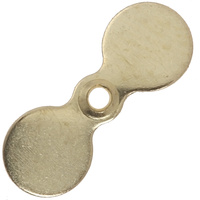
A propeller is an active element intended to rotate or disturb water. It is not simply another cone head. It needs clearance from thread and fibres, and its movement should be tested in water. Local rules may treat rotating or bladed components differently from conventional flies.
Tube-fly components
Cones and front fittings used on tubes must match the outer tube, liner and hook arrangement. Check whether the part is intended to slide, lock or form a junction. A component designed for a hook shank may not be safe on a plastic tube without adaptation specified by the manufacturer.
Where cone heads are useful
- Woolly Buggers and leech patterns requiring a defined front;
- baitfish streamers where fibres should sweep behind the head;
- river and stillwater patterns needing forward weight;
- tube flies built around compatible tubes and liners;
- larger crustacean patterns using a shaped front component.
Cone head or round bead?
A bead creates a compact spherical head and concentrates mass close to one point. A cone forms a longer transition and interacts more strongly with the front materials. Choose the round bead for a compact nymph-like head and the cone where streamer profile and water displacement are part of the design.
Frequently asked questions
Will a tungsten cone fit every streamer hook?
No. Eye, wire and bend geometry determine whether it can be mounted. Check the exact hook and cone.
Is a propeller a type of cone head?
No. It is a moving component whose purpose is rotation or disturbance, even if it is listed beside other front-body parts.
Does a cone always make the hook ride point-up?
No. Orientation depends on weight position, hook shape and the rest of the fly.