
Shooting Heads and Running Lines – Building the System
( number of products: 4 )A shooting-head system pairs a short, weighted casting head with a thin running line that shoots through the guides behind it. It allows the casting section and running line to be selected separately, and in interchangeable systems it can also accept tips of different lengths and densities.
This category contains both shooting heads and running lines. They are not interchangeable parts: check the product type, total head weight in grains, head length, rod recommendation and required tip system before ordering. The difference between total head weight and the AFTMA/AFFTA standard is explained in the main fly-line guide.




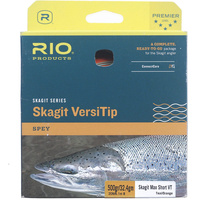


Mastery Atlantic Salmon Sh.Head (Colors TBD) Intermediate / Sink 5


 + 1Opcji
What is the difference between a shooting head and a running line?
The shooting head is the short, heavier part of the system. It loads the rod, forms the loop and carries the fly. The running line has a much smaller diameter and less mass. During the final phase of the cast, the head pulls it through the guides, allowing the cast to extend without carrying the complete line in the air.
Both components are required in a separate-head system. A running line does not provide the necessary casting mass on its own, while a shooting head needs a compatible running line and a secure, streamlined connection.
How to choose head weight in grains
The most reliable starting point is the grain window specified by the manufacturer of the exact rod. That recommendation reflects rod length, action and intended use. For two-handed, switch, Skagit and Scandi rods, do not mechanically convert the AFTMA/AFFTA table for the first 30 feet of a conventional single-handed line.
The grain figure printed on a shooting head normally describes the complete head. The same mass can feel and cast differently in a short, compact head and in a longer, more progressive taper. If a heavy tip forms part of the system, check whether the head manufacturer includes or excludes its mass from the recommended grain window.
Skagit, Scandi and single-handed shooting heads
Skagit
A Skagit head is short and compact, designed to work with a tip and a larger or weighted fly. Its concentrated mass helps form the cast where back-cast room is limited, but correct matching requires the head and tip to be considered together.
Scandi
A Scandi head has a more progressive taper and is intended for lighter flies, polyleaders or light tips. It produces a smoother, finer loop than a typical Skagit system, but is not intended to carry every heavy tip or large fly.
Single-handed and salmon shooting heads
Separate heads are also used with single-handed rods and other salmon-fishing outfits. Head length, total mass, density profile and the recommended running-line type are especially important. A method name never replaces the manufacturer’s line and rod specifications.
Which running line should you choose?
A thinner running line creates less resistance in the guides, but may be harder to hold, more prone to tangling and less comfortable in cold weather. A thicker running line is easier to grip and control on the water, but creates more drag during the shoot.
- Coated running line: resembles a very thin fly line, is easier to hold and manage, and is usually more convenient for mending.
- Monofilament running line: has a very small diameter and low resistance, but requires careful stretching and line management.
- Running line with a handling section: combines a thin shooting portion with a thicker section designed to be held in the hand.
Connections and component compatibility
Check whether the head, running line and tip have factory loops and whether their diameters create a smooth connection. A large, stiff junction can catch in the guides. After assembling the system, make sure the head is fitted in the correct direction; markings or a colour transition often identify the rear.
If the head requires a separate tip, do not replace it with an arbitrary leader. The tip forms part of the casting system and may add substantial mass. The leader begins beyond the tip and provides the final connection to the fly.
How to assemble a shooting-head outfit
- Find the grain window specified for the rod and intended casting style.
- Select a head profile suited to fly size, available space and casting method.
- Choose a tip within the head manufacturer’s recommendations and for the required fishing depth.
- Select a running line that balances low resistance with handling comfort.
- Connect the components loop to loop, confirm the head direction and straighten the running line before fishing.
Frequently asked questions
Does a 300-grain head equal a particular AFFTA line weight?
Not reliably. The AFFTA standard measures the first 30 feet of a conventional line, while 300 grains on a shooting head normally describes the complete head at its own length. Use the grain window stated for the rod.
Will every running line work with every shooting head?
No. Diameter, strength, loop design, temperature behaviour and the mass of the complete system all matter. The running line should pass through the guides without excessive resistance while remaining manageable in the hand.