
Sink-Tip Fly Lines – Choosing Tip Length and Sink Rate
( number of products: 10 )A sink-tip fly line combines a floating or slower-sinking rear section with a sinking front section that takes the fly below the surface. It reaches deeper than a conventional floating line while leaving the rear of the line easier to mend, lift and control.
This category mainly contains complete lines with an integrated sinking tip. Compare tip length, stated sink rate, line weight and head profile: the label Sink 3 or Sink 6 does not by itself describe how the complete line will fish. The parent fly-line guide explains line weights, grains and taper construction.
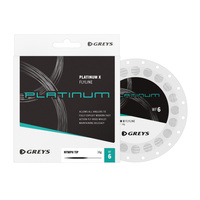


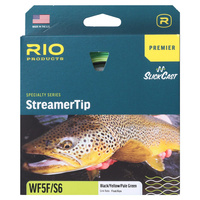


















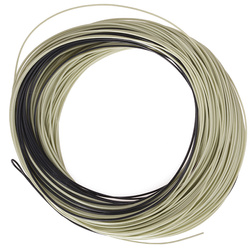

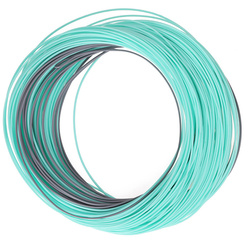





How does a sink-tip fly line work?
Once the front section has sunk, it leads the fly lower while the floating rear makes it easier to mend the line, control its angle and lift it for the next cast. A sink tip is particularly useful in rivers when a streamer or wet fly must travel below the surface, but a full-sinking line would be harder to manage or would descend too deeply.
Different designs create different presentation paths. A short, fast-sinking tip positions the fly differently from a long tip of moderate density. It also matters whether the rear section floats, is intermediate or forms part of a multi-density profile.
Integrated sink tip or interchangeable tip?
On a complete sink-tip line, the sinking front is factory-integrated with the head and running section. Its mass and tapers are designed as one system, making it straightforward to use without matching every component separately.
An interchangeable tip connects to a compatible head or body via a loop. It allows rapid changes of length and density, but its mass must remain within the head manufacturer’s recommendations. A marking such as T-8, T-11 or T-14 is not a sink-rate class: the number indicates the mass in grains per foot of material. Read the actual sink rate separately from the product specification.
Three specifications that matter more than the name
- Sinking-section length: affects depth, presentation angle and how much submerged line must be lifted before the next cast.
- Sink rate: usually stated in ips, it describes nominal descent under controlled conditions; 1 ips equals approximately 2.54 cm per second.
- Mass and taper: the tip must work with the head, rod rating, leader and fly size. A system can cast poorly when it is too heavy even if the chosen density is suitable.
How to choose a sink tip for river fishing
Begin with water depth and current speed, but also consider the direction of the cast. A line cast square across a fast current has less time to sink than one presented farther upstream. A longer or denser tip is not automatically better: it may pass below the intended fishing path, catch the bottom more often or reduce control during the swing or retrieve.
In shallow or moderately deep water, a shorter, slower-sinking front may be sufficient. Faster current or greater depth may require a longer section or higher density. Using a repeatable countdown after each cast makes presentations easier to compare.
How a sinking tip affects the cast
The submerged section must be brought to the surface before it can be cast. Shorten the amount of line left underwater and use a controlled lift or roll cast to reposition the rig. A large weighted fly and heavy tip normally call for a slower stroke and a more open loop than a light dry-fly outfit.
With an integrated line, the complete head profile matters. A streamer taper may carry more mass towards the front so that it can transfer energy efficiently into the sinking section.
Sink tip or full-sinking line?
Choose a sink tip when the fly needs to travel below the surface but you still want the rear of the line to remain easier to control, mend and lift. Choose a full-sinking line when the complete line should descend and carry the fly through a deeper layer without a floating rear section forming a bow at the surface.
Frequently asked questions
Does S3 always mean exactly 3 ips?
Not necessarily. In many product ranges the number is close to the nominal sink rate, but the ranges vary between manufacturers and coating systems. The specification for the exact model and size is the reliable reference.
Does a sink tip require a short leader?
A shorter leader usually keeps the fly closer to the path of the sinking tip. The final length still depends on water clarity, fly buoyancy, current and the depth at which the fly should travel.