
Fly-Fishing Landing Nets — Size, Mesh Type and Carrying System
( number of products: 12 )A fly-fishing landing net should bring the fight to a controlled finish, keep the fish in the water and make hook removal easier. Choose it for the size of fish, the water being fished and the way it will be carried while wading. A hoop that is too small makes landing difficult, while an unnecessarily large net adds weight and drag.
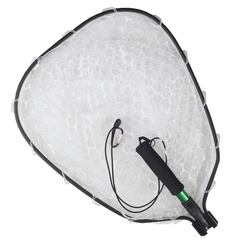
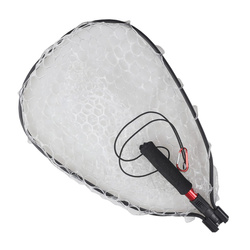
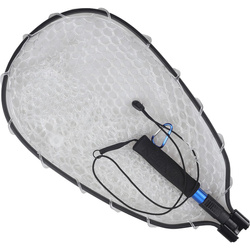
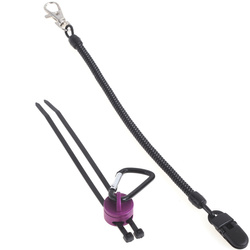
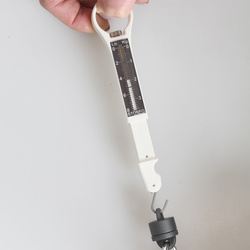
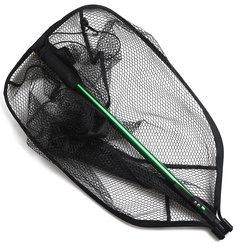
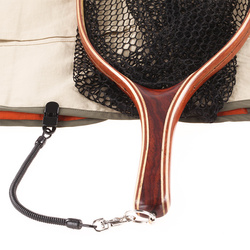
This category includes folding landing nets in several sizes, coated-mesh and silicone-basket variants, plus magnetic releases, clips and coiled safety tethers. Compare the hoop dimensions, basket depth, weight and handle length on the individual product page.

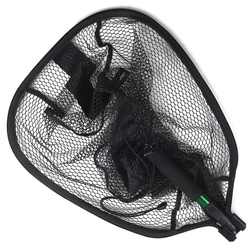
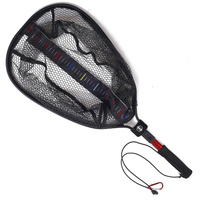
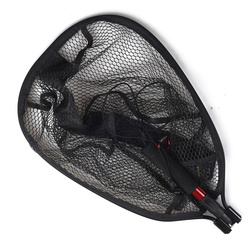

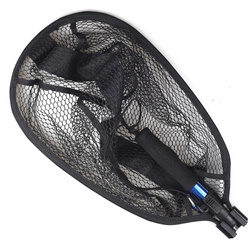









How should you choose a fly-fishing landing net?
The most important measurement is not the net's overall length but the usable hoop and basket size. A fish should enter without being forced through a narrow opening or folded tightly inside the net. The basket must be deep enough to contain the fish, yet still allow it to be supported in the water and unhooked efficiently.
Reach is the second consideration. A short handle is convenient while wading and easy to carry on the back. A longer handle helps from a high bank, platform or boat, or where marginal vegetation prevents a close approach. The landing nets in this range use folding handles, so additional reach does not necessarily mean the same overall transport length.
What net size suits trout, grayling and larger fish?
- Small basket: streams, modest trout and grayling, light tackle and frequent walking. A small hoop is convenient but leaves less margin around an active fish.
- Medium basket: the versatile choice for typical river trout and grayling fishing, adding room while remaining manageable during wading.
- Large, deep basket: larger trout, stillwater fish, sea trout, salmon and other powerful fish taken on fly tackle. A larger hoop makes the final stage easier but demands a secure carrying point.
- Longer handle: high banks, boats and positions where the angler cannot move close to the fish. Reach does not compensate for an undersized hoop.
Do not size the net only for the average catch. If substantially larger fish occur regularly, allow for them. At the same time, a net carried all day must be light and compact enough to remain accessible rather than being left behind.
Coated mesh or a silicone basket?
Polymer-coated mesh remains flexible and collapses close to the hoop, helping the net pack neatly. The coating makes rinsing easier and reduces hook tangling compared with untreated soft mesh. Check the openings and the points where the net joins the frame for wear.
A one-piece silicone basket has a smooth surface, rinses easily and retains less odour. It provides fewer fibres for a hook to catch. Silicone also holds its own shape, can occupy more space in transit and behaves differently in moving water from a light mesh.
Both can work well for fly fishing. The decision also depends on total weight, opening size, basket depth, fly type and carrying method. Apply each property to the exact variant: a product marked “Silicon” has a silicone basket, whereas another model may use mesh merely coated with a silicone-like polymer.
Frame, folding handle and grip
An aluminium frame combines low weight with the rigidity needed to guide the hoop. A folding mechanism reduces transport length, but check that it has locked fully before fishing. Sand and sediment can impede the joint, so rinse it after use.
An EVA grip provides a distinct holding area for wet hands. Even so, do not lift a large fish high above the water with its full weight hanging at the end of the handle. The net is primarily a means of gaining control while the fish remains supported by water, not a carrier for taking it onto the bank.
How do you land a fish correctly?
- Prepare the net early. Release and unfold it before the fish reaches your feet. Check the handle lock and safety tether.
- Submerge the hoop. Do not strike at the fish or chase it with the net. Guide the fish head-first over the opening with steady rod pressure.
- Keep the fish supported by water. Once it is above the basket, raise the hoop only enough to prevent escape. If the fish will be released, do not place it on stones or a dry bank.
- Remove the hook promptly and calmly. Keep the fish submerged, wet your hands before contact and have forceps ready before you begin fishing.
- Allow the fish to leave under its own power. In current, hold it facing into a gentle flow while it regains balance. Do not pump it forcefully backwards and forwards.
A landing net can shorten the final stage of the fight and keep the fish in water during unhooking. It does not replace suitable tippet strength, drag setting or controlled pressure. The tackle should bring the fish in without unnecessary exhaustion.
Mesh and responsible release
For fish that will be released, choose a smooth surface without sharp components or damaged joints. The basket should let the fish lie naturally, and the openings should not allow the head or fins to protrude in a way that risks injury.
The priority is to minimise air exposure and unnecessary handling. Set up a photograph while the fish remains in the submerged net, and lift it only when everything is ready. Do not squeeze the abdomen, place fingers beneath the gill covers or suspend a fish by the tail.
Measuring marks sewn into selected nets can provide a quick estimate without moving the fish onto the bank. Treat this as an approximate measurement: never straighten or press a fish into the mesh simply to obtain a reading.
Magnetic landing-net holders
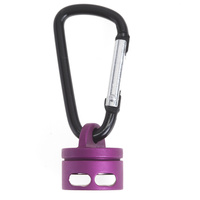
A magnetic release allows the net to ride on a vest or pack and detach with one deliberate pull. One half attaches to the equipment and the other to the net. Position the connection so the hoop does not strike the legs or catch repeatedly on vegetation.
The stated magnetic pull is not the same as a safe net weight. Release direction, walking movement and the added weight of wet mesh all affect the connection. One flat holder in the current range has a pull of about 2.5 kg but is recommended for nets weighing no more than 250 g. Follow the limit given for the exact holder rather than comparing pull figures alone.
Why add a safety tether?
A magnet provides fast access, but once separated it cannot prevent the net from floating away. A coiled tether connects the net to a vest, pack or belt while keeping loose cord to a minimum. It should extend far enough for comfortable landing without remaining under constant tension.
Clip the tether to an independent, secure point. Before entering the water, inspect the clips and coil and make sure the arrangement cannot entangle the fly line. A tether secures equipment; it is not intended for lifting a net containing a fish or dragging it along the bottom.
Cleaning, drying and moving between waters
After use, rinse the basket, frame and folding joint to remove sand, silt and plant matter. Store the net only after it has dried fully. Leaving wet mesh in a vehicle encourages odour and deposits and can promote corrosion of metal components or any hook left behind.
When moving between waters, follow local biosecurity and disinfection rules. Landing nets, waders and boots can transfer organisms and biological material. Shaking off visible debris is not a substitute for any required cleaning, drying or disinfection process.
Frequently asked questions
Is a larger landing net always safer?
No. The basket must contain the fish, but an oversized net is heavier, harder to carry and creates more drag. Appropriate dimensions, basket material and landing technique work together.
Is a magnetic holder enough without a tether?
It may support the net while walking, but after intentional or accidental release it cannot stop the net from drifting away. A separate tether is sensible protection.
Is silicone always better than coated mesh?
No. Silicone is smooth and easy to rinse, while coated mesh can be lighter and pack more closely. Compare dimensions, weight and carrying method for the individual model.