
CDC Feathers for Dry Flies and Emergers
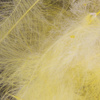
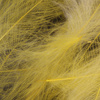
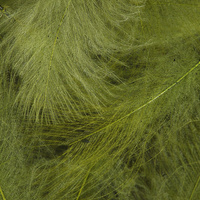
( number of products: 14 )CDC, or cul de canard, is fine plumage from around the preen-gland area of ducks and other waterfowl. Its branching barbs and barbules trap air and create a mobile, translucent outline, making CDC useful in dry flies, emergers, nymphs and patterns fishing in the surface film.
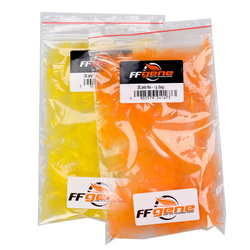
Full selected feathers, bulk packs, duck and goose CDC, puffs, oiler puffs and CDC dubbing are different forms rather than grades of the same component. Choose the form for the tying operation.
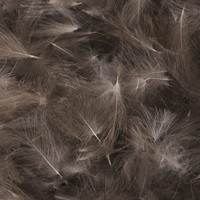
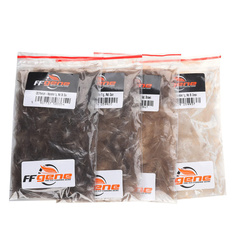


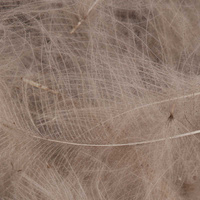
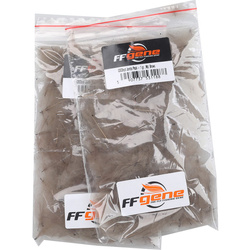





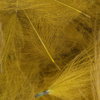

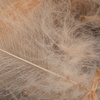




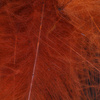









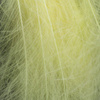


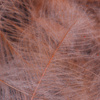
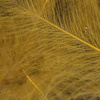
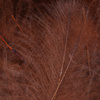


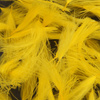
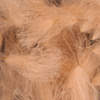
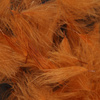

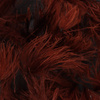

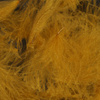
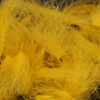



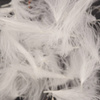


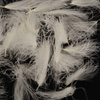


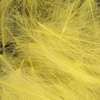
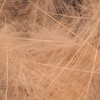

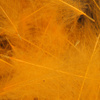


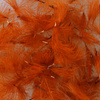


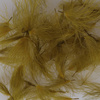
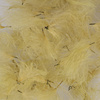


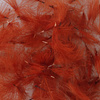

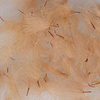


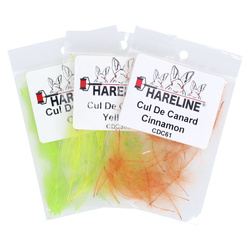




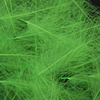













CDC floats through structure, not grease alone
Natural oils contribute to the behaviour of fresh plumage, but the fine branching structure and trapped air are fundamental. Washing does not automatically destroy CDC, and adding heavy general-purpose floatant does not restore a crushed feather. Preserve the fibre structure and use only compatible treatment.
Full feather, puff or dubbing?
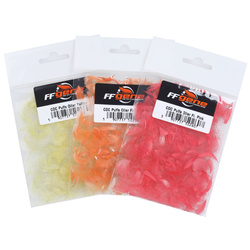
Full CDC feathers provide a stem and aligned barbs for wings, collars and loop techniques. Puffs and oiler puffs have very fine fibres with little useful stem, ideal for small wings, posts and emerging shucks. CDC dubbing creates delicate bodies and thoraxes without requiring a whole feather.
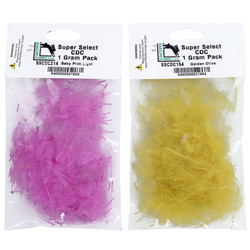
Bulk and selected packs
Selected feathers offer more predictable size and shape. Bulk or weight-based packs provide varied feathers for multiple techniques but require sorting. Visible volume does not directly indicate usable feather count because size and compression differ.
Duck and goose CDC
Goose CDC is often larger or more substantial, while duck CDC covers a broad range of delicate work. Species labels describe origin, not an absolute quality hierarchy. Assess barb length, density, stem and the required fly size.
Uses
- upright and spent wings on dry flies;
- emerging wings and shucks in the surface film;
- soft collars on nymphs and wet flies;
- split-thread and loop hackles;
- fine dubbing and mixed bodies.
Tying without destroying movement
Handle CDC by the stem or tips and avoid coating the working fibres with adhesive. Use controlled thread pressure; excessive tight wraps can cut stems or flare a wing unpredictably. When trimming a wing, retain useful offcuts for dubbing or loops.
Drying and treatment
Rinse slime where necessary, blot the fly gently with amadou or absorbent material, then use a desiccant or floatant explicitly suitable for CDC. Do not rub the feather into a solid mat. A badly fouled fly may need to be changed and cleaned properly later.
Natural, dyed and UV-treated colours
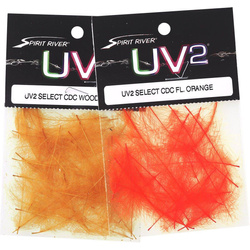
Natural shades create subtle tonal variation. Dyeing provides repeatable bright or dark colours but may influence feel. UV-branded treatments can affect fluorescence or reflection; they do not replace ordinary colour and structure.
Frequently asked questions
Is CDC only for dry flies?
No. Its movement and translucency are valuable in emergers, wet flies and nymph collars.
Are puffs inferior to full feathers?
No. They are a different structure suited to small wings, posts and shucks.
Must wet CDC be discarded?
No. It can often be rinsed, dried and restored if the fibres are not damaged.
Does every dry-fly floatant suit CDC?
No. Heavy or incompatible products can collapse the fibres. Use a CDC-specific treatment.