


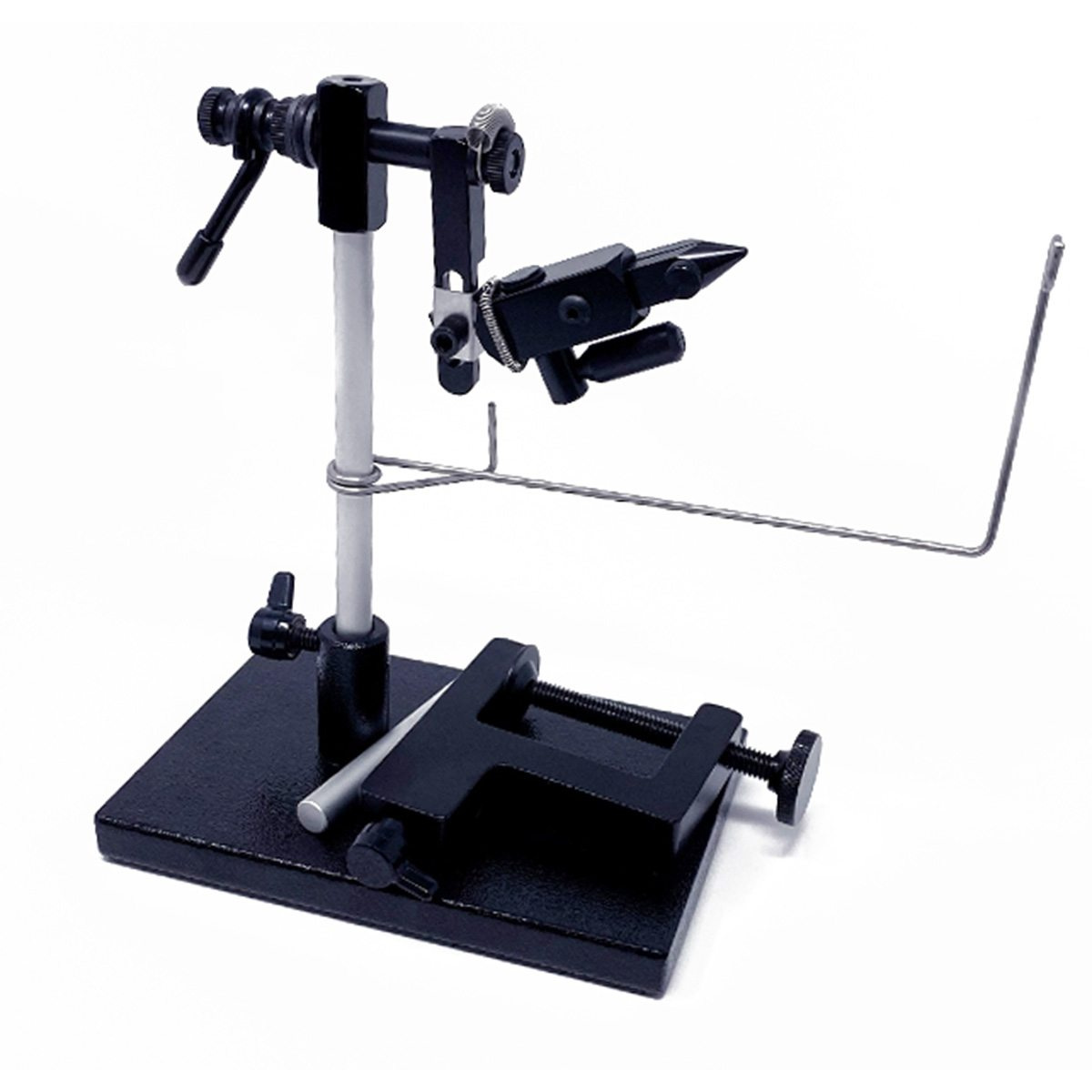
Griffin Odyssey Spider Cam Vise
Griffin Odyssey Spider Cam Vise is a fly-tying vise combining cam-operated jaws with true rotary action. Within Griffin’s rotary vise family, it is distinguished by a straightforward, lightweight design and a quick method of securing the hook. The stated jaw capacity runs from hook sizes #28 to 4/0, allowing the same tying station to handle very small flies, standard nymphs and dry flies, as well as larger streamers. Such a broad range still requires the jaw opening to be matched carefully to the wire diameter of the particular hook.
The cam mechanism is especially useful when tying repeated patterns. Once the jaws have been adjusted for the hook, a positive movement of the lever provides the final clamping action without requiring the entire mechanism to be tightened again for every change. Seat a stable section of the hook bend between the jaws while keeping the shank and eye accessible. The lever should close with noticeable resistance, but excessive force should not be used to compensate for an incorrect jaw setting. Before adding materials, gently test the hook to confirm that it will not twist or slide when tying thread is placed under tension.
True 360° rotary operation allows the hook shank to follow the rotational axis of the head. This makes it easier to inspect the fly from every side, apply adhesive or resin, and produce even wraps of wire, tinsel, dubbing and other body materials. Before using continuous rotary techniques, view the hook from the side and check that the shank does not describe a pronounced circle as the head turns. Rotation can also be used simply to inspect the underside of a pattern while most tying is completed with the head stationary. Griffin Odyssey Spider Cam Vise therefore fits both one-off tying and batch work where quick hook changes and repeatable positioning help maintain a consistent workflow.
Jaw operation, hook range and practical setup
- Cam-operated jaws support quick, convenient hook changes.
- The stated hook capacity extends from #28 to 4/0.
- True 360° rotary action places the shank on the rotational axis.
- Grip stability should be checked carefully near either end of the hook range.
- Confirm the hook’s side-on alignment before continuous rotary wrapping.